Living in a Biosphere
What does the Cape Winelands Biosphere Reserve mean for Franschhoek and the landscape we call home?
Look across the Franschhoek Valley and it is easy to see what makes this place special. Mountains surround vineyards and farms, rivers and streams move through the valley, and patches of natural fynbos remain on the slopes.
But Franschhoek is part of something much bigger.
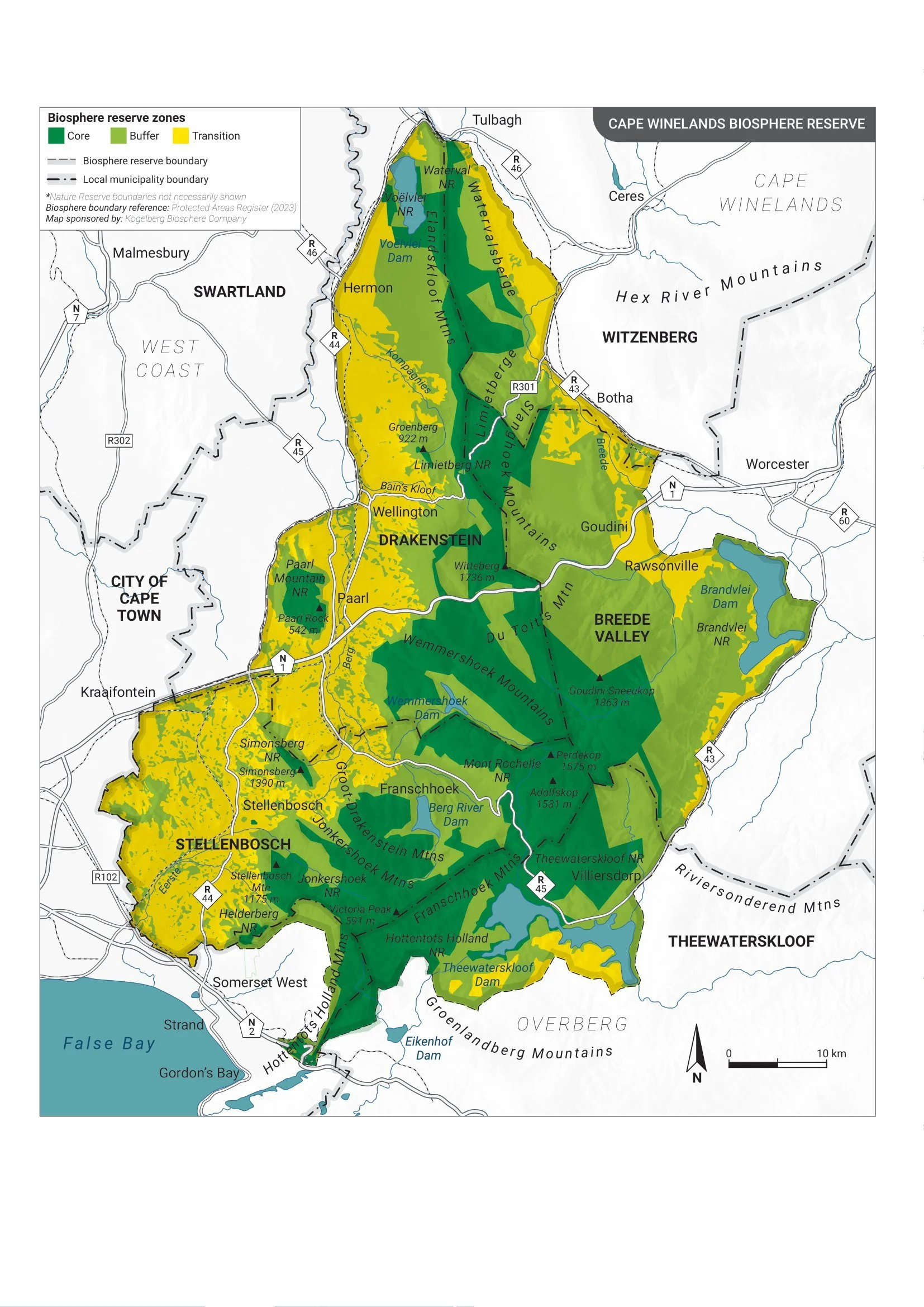
The valley forms part of the Cape Winelands Biosphere Reserve (CWBR), an internationally recognised landscape where conservation, sustainable development, education and people come together. The CWBR was designated by UNESCO in 2007 and covers approximately 322,000 hectares across parts of the Western Cape.
But what exactly is a biosphere reserve and what does it mean for those of us who live here?
More than a nature reserve
A biosphere reserve is not simply another type of nature reserve. It is a place where people and nature are considered part of the same system.
Through UNESCO's Man and the Biosphere Programme, biosphere reserves around the world provide opportunities to demonstrate how biodiversity can be conserved while communities continue to live, work and develop sustainably.
This means that a biosphere reserve is not about putting a fence around nature or stopping human activity. Instead, it is about finding ways for people and the environment to thrive alongside one another.
The approach is built around three closely connected ideas: conservation, sustainable development, and research, education and learning.
And these ideas are particularly relevant in the Cape Winelands.
A landscape of connections
Looking at a map of the Cape Winelands Biosphere Reserve puts Franschhoek into perspective. The reserve encompasses a diverse landscape of mountains, valleys, vineyards, farms, towns and natural areas.
The region forms part of the Cape Floristic Region, one of the world's most remarkable areas for plant diversity. The fynbos landscapes surrounding Franschhoek are home to an extraordinary variety of plant species, many of which occur nowhere else on Earth.
But biodiversity does not exist in isolation.
The mountains surrounding the valley form part of important water catchments. Rivers and streams connect different parts of the landscape, while healthy soils, natural vegetation and pollinators all contribute to functioning agricultural systems.
What happens in one part of a catchment can therefore affect people and ecosystems further downstream.
This is one of the reasons why thinking beyond individual properties, farms or protected areas is so important.
Why does it matter to Franschhoek?
For people living in Franschhoek, the term biosphere reserve can sometimes feel like a distant environmental designation. In reality, it is closely connected to the things that make the valley what it is.
The landscape supports agriculture, tourism, businesses and communities, while the natural environment provides essential services such as water, soil protection, pollination and habitat for biodiversity.
The challenge is finding a balance.
How do we continue to support livelihoods while protecting the natural systems on which those livelihoods depend? How do we maintain the character and biodiversity of the valley while responding to the needs of a growing community?
There are no simple answers. But a biosphere reserve provides a framework for bringing different people and organisations together to ask these questions and work towards practical solutions.
Learning for the future
One of the most important parts of creating a sustainable future is education.
Environmental education is not only about learning the names of plants or identifying animals. It is about understanding how the systems around us work and recognising our place within them.
Through programmes such as Education on the Move, the CWBR brings practical environmental and science learning to schools and communities across the region. Learners can investigate topics including water, biodiversity, soil, pollution and waste through hands-on activities.
These experiences can change the way young people see the places around them. A river becomes more than water flowing through a valley. A patch of fynbos becomes a living ecosystem. A mountain becomes part of a catchment rather than simply a beautiful backdrop.
By encouraging curiosity and environmental awareness, education can help develop the next generation of people who understand and care about the landscape they call home.
A shared landscape
Perhaps the most important thing about living in a biosphere reserve is the reminder that we are connected to the environment around us.
The mountains, rivers, farms, vineyards, natural areas, businesses, schools and communities of the Cape Winelands are not separate pieces. They form part of one interconnected landscape.
And caring for that landscape is not the responsibility of one organisation or one group of people. Farmers, residents, businesses, schools, conservationists, scientists, government and visitors all have a role to play.
So, the next time you look across the Franschhoek Valley, perhaps look beyond the familiar postcard view.
Think about the water moving through the mountains, the fynbos growing on the slopes, the farms and people that depend on the landscape, and the young people who will inherit it.
We are not simply living in a beautiful landscape. We are part of a living landscape.
And being part of a biosphere reserve is an invitation to understand that connection—and to consider what we can do today to ensure that this landscape continues to support both people and nature into the future.