
To Bee or not to Bee
From the archives.
An article by Stephen Smuts, originally published on the Cape Winelands Biosphere Reserve website on the 20th November 2019.
If you are like me, if you said bees, you would immediately think of hives with swarms of bees producing wonderful sweet honey but also that a bee can give you a nasty sting.
BUT not all bees are honeybees. This I learnt attending a lecture given by Jenny Cullinan, who studies all wild bees, social, semi-social and solitary.
Solitary bees by design are the main fynbos pollinators however the introduction of a great many honeybees hives is proving a problem to them and their numbers are declining. The high density of honeybees means that despite them not being as efficient pollinators as solitary bees, their high numbers mean they outcompete the solitary and semi-social bees. Another factor leading to their decline is that bees need a temperature of 25 degrees to fly. Social/honeybees reach this temperature earlier in the day as the nest warms earlier because of combined body temperature. Semi-solitary and solitary bees need the day to warm up before they can fly. This too means many flowers have already been pollinated by honey bees before they can be reached by their more solitary cousins.
Back 130 million years ago all plants were wind pollinated – no bees - however there were insect- eating wasps. The evolution to bees came about as flowers were producing pollen which the wasps realised was also protein. This discovery led to the evolution of bees, a specialised species of wasp totally dependent on flowers. This also led to flowers becoming more attractive as they discovered that there was an alternative to wind pollination. The more noticeable the flower, the more likely it would attract bees. Interestingly, bees however do not see red so the role of pollination of red flowers is filled by butterflies.
The bees also evolved a fascinating way to harvest pollen bearing in mind that they do not have baskets or hands. As they fly, they generate static electricity, so the pollen attaches itself to the bee.
Some bees are species specific so if a plant species goes extinct, so does that species of bee.
Carpenter bees, a species of solitary bee, is a buzz pollinator. Here the bee lands on a flower – an example is the flower of a Keurboom – grasps the flower and buzzes on the note of C. On ‘hearing’ this, the flower releases its pollen. A buzz pollinated flower will not release pollen to a honeybee.
Solitary and semi-solitary bees look after their young. Carpenter bees for example, excavate tunnels in wood in which they lay their eggs and raise their young. One bee species female nests in the ground whereas the male will sleep overnight in loose sand such as a mole rat run. In the case of semi-social bees, the adults raise their babies with the help of her earlier brood. They don’t make actual honey but, as pollen goes off quickly, they preserve the pollen with sugar.
This is just a taste of what there is to learn about bees and the ecological role they play in pollination. If you ever get the chance to attend a Jenny Cullinan talk, grab it. Her passion for bees and their conservation is infectious. She is writing a book on her research but until then, there is lots on the internet so go read more about these fascinating creatures.
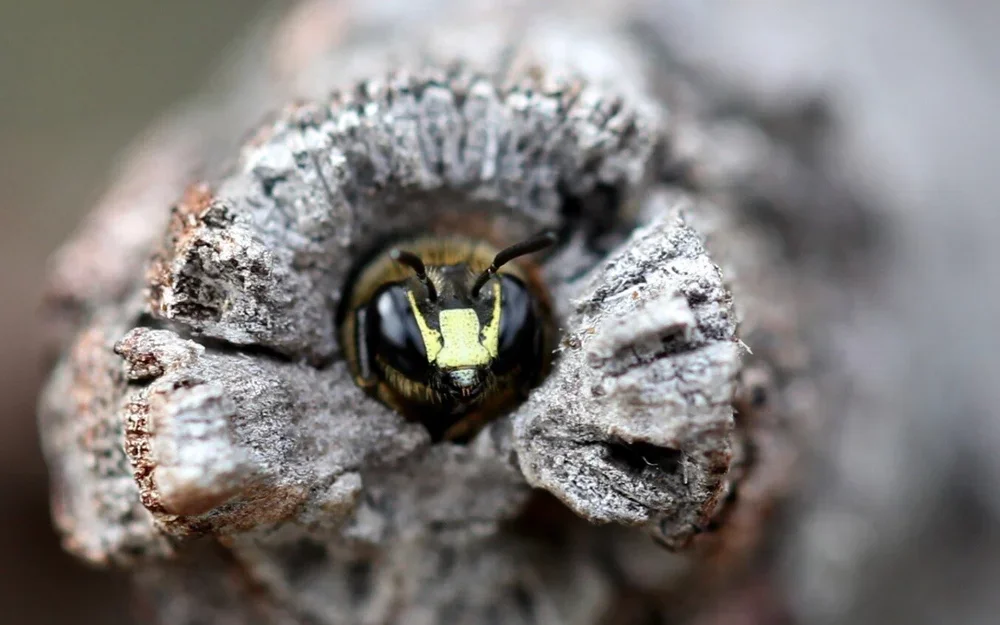
A solitary bee. The head of an allodapine bee protruding from the entrance to its nest in the tip of a dead pincushion bush.
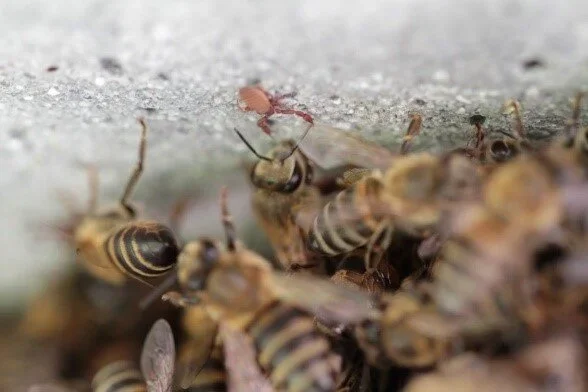
“The chelifer found in South Africa is mostly Ellingsenius fulleri and is believed to be a predator of small mites, wax moth larvae and other arthropods found in the nest debris. They often cling onto the legs of bees and are believed to be spread in this way to other colonies” (Geoff Tribe). ujubee.com